Predictive Maintenance: The Ultimate Guide to Reducing Downtime
Key Takeaways
-
Predictive maintenance (PdM) is a condition-based maintenance strategy that uses real-time sensor data, IoT devices, and data analytics to predict equipment failures before they happen, allowing maintenance to be scheduled only when it's needed.
-
By targeting repairs only when necessary, PdM can reduce maintenance costs by up to 30% and eliminate unplanned downtime, which costs manufacturers up to $2.3 million per hour, delivering up to 10 times the ROI.
-
Effective PdM requires matching specific monitoring techniques to asset failure modes, ranging from vibration analysis for rotating machinery to infrared thermography for electrical systems and AI for complex, multi-variable environments.
-
Successful implementation is a seven-step process that relies on establishing baseline normal behavior and integrating sensor data directly into a CMMS to automate work orders and technician assignments.
-
PdM isn’t a one-size-fits-all solution, so it should be prioritized for high-criticality assets with measurable degradation periods rather than low-value items or those with instantaneous failure modes.
Predictive maintenance (PdM) is a condition-based maintenance strategy that uses real-time sensor data, IoT devices, and data analytics to predict equipment failures before they happen. That means maintenance is scheduled only when needed.
Unplanned equipment downtime costs industrial manufacturers up to $2.3 million per hour. Behind the majority of those losses is a simple, avoidable problem: Nobody saw the failure coming.
Predictive maintenance solves that issue. Rather than fixing equipment after it breaks (reactive maintenance) or servicing it on a fixed calendar schedule regardless of its condition (preventive maintenance), predictive maintenance continuously monitors the health of your assets and triggers a repair order only when data signals something is about to go wrong.
This makes predictive maintenance the most data-driven and cost-efficient maintenance strategy available. When implemented properly, it all but eliminates unexpected failures, reduces maintenance costs by 25%–30%, and delivers a return on investment of up to 10 times, according to the U.S. Department of Energy.
Learn More: Compare Predictive Vs Condition-Based Maintenance
A Brief History of Predictive Maintenance
Predictive maintenance as a formal discipline emerged in the late 1990s and early 2000s, initially driven by the aerospace and defense industries, where equipment failure has life-or-death consequences.
Early PdM programs relied on periodic, offline monitoring. This included a vibration technician visiting a machine once a month with a handheld meter, recording readings in a logbook, and manually comparing them to previous measurements. This was a significant improvement over reactive maintenance but was limited by the time between inspections.
The widespread adoption of industrial IoT (IIoT) devices in the 2010s transformed predictive maintenance. Affordable, wireless sensors capable of streaming continuous data to cloud platforms made online, real-time condition monitoring accessible to mid-size facilities, not just large aerospace or energy companies.
The integration of artificial intelligence and machine learning in the current era is driving the next evolution. Modern platforms can ingest data from hundreds of sensors simultaneously, automatically learn each asset's normal behavior, detect multi-variable failure precursors, and update failure probability scores in near real time without requiring manual configuration.
Predictive vs. Preventive vs. Reactive Maintenance
To fully understand predictive maintenance, it helps to see where it sits relative to other maintenance strategies.
|
Maintenance Type |
What Triggers It |
Typical Cost |
Downtime Risk |
|
Reactive (Run-to-Failure) |
Equipment breaks |
Low up front, high repair |
High — unplanned |
|
Preventive (Time-Based) |
Calendar schedule |
Moderate |
Medium — may over-maintain |
|
Predictive (Condition-Based) |
Sensor/Data threshold crossed |
Higher up front, low ongoing |
Very low — data-informed |
With reactive maintenance, you wait until a machine fails. The repairs are often urgent and expensive, spare parts may not be on hand, and production can grind to a halt.
With preventive maintenance, you service equipment on a schedule, whether it needs it or not. This reduces breakdowns but can lead to unnecessary labor and parts costs.
Predictive maintenance solves both problems. Maintenance happens only when sensor data indicates a failure is approaching. No wasted service calls, no surprise shutdowns.
Manager’s Pro Tip
Predictive maintenance and preventive maintenance are often used interchangeably, but they're distinct strategies. Preventive maintenance is calendar-driven, while predictive maintenance is data-driven.
How Does Predictive Maintenance Work?
Predictive maintenance is a three-step feedback loop that includes monitoring asset condition in real time, analyzing data against baselines, and taking action through work orders.
Monitor Asset Condition in Real Time
Sensors are attached to critical assets. These devices continuously capture condition data and stream it to a central platform.
Analyze Data Against Established Baselines
Before sensors are deployed, maintenance teams must establish a condition baseline to see what normal looks like for each asset. Once live data begins flowing, any deviation from that baseline is automatically flagged.
Modern predictive maintenance platforms apply machine learning models to this data and use AI to identify subtle patterns that precede failure weeks or months before a human technician would notice them.
Trigger Work Orders Automatically
When a threshold is crossed, the computerized maintenance management system (CMMS) automatically generates a work order, assigns it to the right technician, and logs the anomaly for future analysis. The result is maintenance work is performed exactly when needed, with full context about what's wrong and why.
Types of Predictive Maintenance Techniques
Different assets fail in different ways, which means different monitoring techniques are needed. Here's a breakdown of the most widely used predictive maintenance methods:
1. Vibration Analysis
Vibration analysis is the most widely deployed predictive maintenance technique in manufacturing. A vibration sensor or accelerometer is attached near the bearings of rotating equipment and measures the frequency and amplitude of mechanical movement. When values deviate from the baseline due to imbalance, misalignment, looseness, or bearing wear, the system flags the anomaly.
A single accelerometer attached to a pump motor can provide continuous, 24/7 insight that previously required a skilled technician and a handheld meter.
Best for: High-speed rotating machinery (pumps, motors, fans, compressors)
Cost: Medium
Lead Time Before Failure: Weeks to months
2. Infrared Thermography
Every piece of equipment has a thermal signature. When a component begins to fail, whether through a loose electrical connection, an overloaded circuit breaker, or a failing motor bearing, it generates excess heat before any visible or audible symptom appears.
Infrared cameras capture this heat pattern as a visual thermal image. Maintenance teams can scan an entire electrical switchgear cabinet in minutes and immediately identify hot spots.
Best for: Electrical panels, transformers, motors, HVAC systems
Cost: Low to medium
Lead Time Before Failure: Days to weeks
3. Ultrasonic Analysis
Ultrasonic analysis detects high-frequency sounds (typically in the 20–100 kHz range) that are inaudible to the human ear. They’re generated by friction in failing bearings, turbulent flow from leaks in compressed air systems, or the discharge and arcing of electrical faults.
Ultrasonic detectors are often considered the most sensitive early-warning tool available for bearing failure.
Best for: Compressed air/gas leaks, steam trap failures, electrical arcing, bearing lubrication
Cost: Medium to high
Lead Time Before Failure: Weeks to months
4. Acoustic (Sonic) Analysis
Sonic acoustic analysis uses audible-range sound to monitor equipment condition. It's particularly popular among lubrication technicians, who use handheld acoustic devices to determine whether a bearing needs grease, avoiding under-lubrication (which causes wear) and over-lubrication (which causes overheating and seal damage).
Best for: Low- and high-speed rotating machinery, lubrication monitoring
Cost: Low
Lead Time Before Failure: Days to weeks
5. Oil and Fluid Analysis
By analyzing a small oil sample from a machine, laboratories can identify metal particles, water contamination, viscosity changes, and chemical degradation, all of which are early indicators of internal wear.
Oil analysis is like a blood test for machinery: A spike in iron particles in a gearbox sample indicates gear tooth wear. Catching this early allows the team to schedule a gearbox inspection before catastrophic failure occurs. Many fleets of diesel trucks and mining equipment rely on oil analysis programs to extend engine life and avoid expensive overhauls.
Best for: Gearboxes, hydraulic systems, diesel engines, turbines
Cost: Low
Lead Time Before Failure: Weeks to months
6. Electrical Signature Analysis (ESA)
Electrical signature analysis monitors the voltage and current waveforms of electric motors. Anomalies in these signals, which are caused by rotor bar defects, eccentricity, or mechanical load issues, can be detected without physically touching the motor or taking it offline. ESA is especially valuable in environments where physical sensor access is difficult, such as submersible pumps or motors in hazardous areas.
Best for: Electric motors, drives, generators
Cost: Medium
Lead Time Before Failure: Weeks to months
7. AI and Machine Learning-Based Monitoring
Modern predictive maintenance platforms increasingly layer artificial intelligence on top of sensor streams. Rather than monitoring a single variable against a fixed threshold, AI models ingest data from dozens of sensors simultaneously, identify complex multi-variable failure patterns, and generate failure probability scores updated in real time.
This approach is particularly powerful for assets with complex, interdependent failure modes such as wind turbines, jet engines, or continuous process equipment, where no single sensor can tell the full story.
Best for: Complex systems generating large volumes of multi-sensor data
Cost: High up front, very high ROI at scale
Lead Time Before Failure: Months (with sufficient training data)
How to Implement Predictive Maintenance: A Step-by-Step Guide
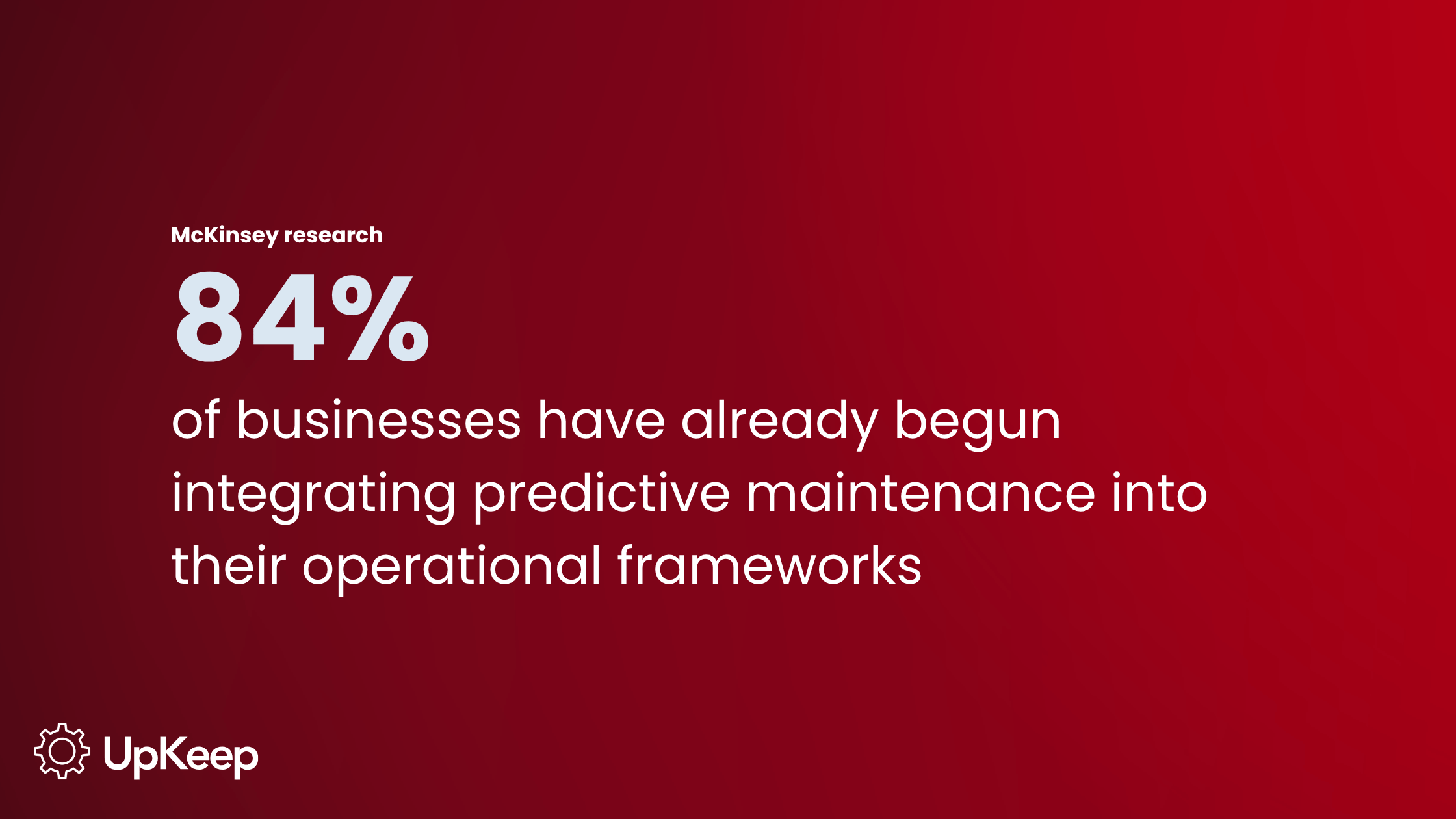
McKinsey research indicates that 84% of businesses have already begun integrating predictive maintenance into their operational frameworks.
Rolling out a PdM program is now more than a technology purchase. It’s become a strategic investment. Here's how to do it right:
Step 1: Conduct an Asset Criticality Assessment
Not every asset justifies predictive maintenance. Start by ranking your assets by criticality: What’s the impact on production or safety if a failure occurs? What’s the cost to repair? How often does this asset fail?
Focus predictive maintenance investment on assets that are high criticality, high cost to fail, and have a measurable degradation period.
Learn more: Understanding and Performing Criticality Analysis in Maintenance
Step 2: Define Condition Baselines
Before installing sensors, collect baseline data under normal operating conditions. This gives you control to compare live readings against typical ranges. Without a reliable baseline, threshold alerts are meaningless.
Step 3: Select the Right Sensors and Techniques
Match your monitoring technique to your asset type:
-
Rotating machinery (pumps, motors, fans) → vibration analysis
-
Electrical equipment (panels, transformers) → infrared thermography or ESA
-
Compressed air/steam systems → ultrasonic analysis
-
Engines and gearboxes → oil analysis
-
Complex multi-system assets → AI/ML monitoring platform
Step 4: Deploy IoT Devices and Connect to a Data Platform
Install sensors and connect them to your IIoT platform or directly to your CMMS. Confirm data transmits cleanly and at the correct sampling rate before moving on.
Step 5: Integrate With Your CMMS
Your CMMS is the operational engine behind predictive maintenance. Configure it to automatically generate work orders when sensor thresholds are crossed, assign them to the right technician, and log the asset's condition data against the work order for future trend analysis.
Step 6: Train Your Maintenance Team
Sensor data is only useful if your team knows how to interpret it. Invest in training that covers how to use the predictive maintenance platform and how to read and interpret sensor data and understand what specific anomalies mean for specific asset types.
Step 7: Review, Analyze, and Continuously Improve
Predictive maintenance programs improve over time. Review your alert history quarterly. Are thresholds generating too many false positives? Are there failure patterns your sensors are missing?
Continuous calibration is what separates a world-class PdM program from one that gathers dust after the initial rollout.
Is Predictive Maintenance Right for Your Organization?
Predictive maintenance is a powerful tool, but it isn't the right fit for every organization or asset. Use this quick decision framework to assess readiness:
Strong candidates for PdM:
-
Large industrial operations with high-value rotating or electrical equipment
-
Facilities where unplanned downtime is extremely costly (e.g., manufacturing, oil and gas, utilities, healthcare)
-
Organizations that have already implemented a preventive maintenance program and are looking to optimize further
-
Operations with the data infrastructure and technical staff to support sensor integration and CMMS connectivity
Less suitable for PdM:
-
Small operations with low-criticality assets and inexpensive replacement parts
-
Organizations that haven’t yet implemented basic preventive maintenance
-
Assets with instantaneous, unpredictable failure modes where no degradation period exists
Manager’s Pro Tip
Low-value assets with cheap replacement costs, assets with instantaneous failure modes (like fuses or light bulbs), or organizations that haven't yet implemented basic preventive maintenance are better served by simpler strategies. PdM ROI scales with asset criticality and failure cost.
Real World Examples of Predictive Maintenance
Predictive maintenance is being applied across numerous sectors to reduce downtime, lower costs, and enhance safety. Here are some specific, real-world examples of its application in industries.
Healthcare
Predictive systems monitor critical assets like MRI machines by tracking metrics such as helium levels, cooling system performance, and magnetic field stability. This minimizes costly scanner outages that can delay hundreds of patient procedures.
Aviation
Commercial aircraft engines use hundreds of sensors to continuously stream performance data to ground-based analytics systems. Airlines use AI and machine learning to identify anomalies in fuel burn, vibration, and temperature, allowing parts to be replaced proactively during scheduled gate time before a fault develops mid-flight.
Manufacturing
A large automotive parts manufacturer can install vibration sensors on electric motors across the plant floor. When the vibration amplitude exceeds a defined threshold, the CMMS automatically generates a work order, enabling a bearing replacement weeks before a projected failure.
Facility Management
Facilities managers oversee systems like rooftop HVAC units. Remote sensors monitor conditions like vibration and temperature continuously to eliminate the need for manual inspections in hazardous locations and prevent major system failures.
Agriculture
Large-scale farming operations use oil and fluid analysis programs for their combines and tractors. By analyzing oil samples for metal particles and contamination, they can predict wear on diesel engines and hydraulic systems, allowing high-cost components to be serviced before failure during critical harvesting periods.
Hospitality
Large hotels utilize real-time temperature and vibration sensors on massive HVAC chiller units and boilers, which are critical for guest comfort. Predictive monitoring helps prevent catastrophic climate control failures that would otherwise lead to immediate guest complaints and lost revenue.
Government and Public Works
Water utilities monitor high-pressure pumping stations using vibration analysis and acoustic sensors. This technique predicts mechanical failure in remote assets, preventing disruptions in public water services and ensuring compliance with utility standards.
The Benefits and ROI of Predictive Maintenance
The financial case for PdM is compelling, but some of its most important benefits don't show up directly in a maintenance cost line item.
Improved workplace safety
According to the Liberty Mutual’s Workplace Safety Index, equipment failure is one of the leading causes of occupational injuries and fatalities in industrial environments. Predictive maintenance reduces these emergencies by addressing issues under controlled, pre-planned conditions.
Remote monitoring also means maintenance personnel spend less time in physically dangerous areas. Sensors on a rooftop HVAC unit or a submersible pump instead report condition data continuously, eliminating the need for manual inspections in hazardous locations.
Longer asset lifespan
In some cases, the combination of predictive and preventive maintenance can effectively increase the operational lifespan of fixed assets. That has significant capital expenditure implications for asset-intensive industries.
Catching failures before they occur and scheduling targeted repairs is fundamentally better for asset health than either running it to destruction or over-servicing it with unnecessary scheduled maintenance.
Better spare parts planning and inventory efficiency
Because predictive maintenance gives a warning of failures, procurement becomes proactive rather than reactive. Teams can source the exact parts needed before beginning a repair, which eliminates both the costly delays of emergency procurement and the carrying costs of large safety stock inventories.
This is particularly valuable in facilities with long lead times for specialized components, where an unplanned failure could mean weeks of downtime waiting for a part.
Regulatory compliance and insurance advantages
Many industries, such as oil and gas, food processing, pharmaceutical manufacturing, aviation, and healthcare, often require documented evidence of equipment condition monitoring for regulatory compliance. A PdM program with a robust, time-stamped sensor data trail satisfies auditors, regulators, and insurance underwriters in a way that time-based maintenance logs can’t.
Some insurers actively incentivize organizations with established PdM programs, recognizing their measurable impact on reducing safety hazards and catastrophic equipment losses.
Energy efficiency as a hidden benefit
One perk that doesn’t often come up in maintenance ROI discussions is energy consumption. Equipment operating outside of optimal condition consumes more energy to produce the same output. Predictive monitoring of energy draw patterns, combined with vibration and thermal data, allows facilities teams to catch efficiency degradation early.
Manager Pro Tip
One of the strongest external validators of PdM's value proposition is the accelerating pace of investment in the space. According to research, the global predictive maintenance market size was valued at USD 10.93 billion in 2024 and is predicted to reach USD 70.73 billion by 2032. That rate of expansion explains the documented returns by early adopters of this technology.
Get Reliable Foresight for All Your Assets With Predictive Maintenance
Predictive maintenance represents the evolution of equipment upkeep from an art to a science. By anchoring maintenance decisions in real time, objective data rather than schedules or guesswork, organizations can dramatically reduce costs, extend asset life, improve worker safety, and turn their maintenance department from a cost center into a genuine competitive advantage.
Want to learn more about how predictive maintenance can serve your organization? Talk to someone on the UpKeep Team today!
Frequently Asked Questions About Predictive Maintenance
What is predictive maintenance?
Predictive maintenance (PdM) is a proactive maintenance strategy that uses real-time condition data, collected by sensors and analyzed by software, to predict when a piece of equipment is likely to fail, so maintenance can be performed before that failure occurs. It’s a step above both preventive and reactive maintenance.
What is the difference between predictive and preventive maintenance?
Preventive maintenance is scheduled based on time or usage intervals (e.g., every 30 days or every 500 operating hours), regardless of the asset's actual condition. Predictive maintenance is triggered by real-world condition data, meaning maintenance only happens when the data says it's needed. PdM reduces unnecessary maintenance labor and parts costs compared to a purely preventive approach.
How much does predictive maintenance cost to implement?
Implementation costs depend heavily on the number of assets, the specific sensors used, and your software needs. Small companies can expect a cost of around $15,000, while enterprise setups are estimated to be $50,000-$100,000. To get a precise view of the potential ROI for your facility, consider requesting a scoped assessment from a CMMS provider.
What industries benefit most from predictive maintenance?
Manufacturing, oil and gas, energy and utilities, aviation, mining, healthcare facilities management, and commercial real estate all see strong returns. Any industry with expensive assets, high downtime costs, or safety-critical equipment is a good candidate for predictive maintenance.
What technology is used in predictive maintenance?
The technology stack for predictive maintenance typically includes: IoT sensors (vibration, temperature, ultrasonic, current), an IIoT gateway or edge computing device, a cloud or on-premise data platform, a CMMS for work order management, and, in more advanced programs, machine learning models for anomaly detection and failure prediction.
Want to keep reading?
Return on Investment (Predictice Maintenance)
What Is Predictive Maintenance in Manufacturing?
The 6 Sensors for Predictive Maintenance That Optimize Repair Timelines
4,000+ COMPANIES RELY ON ASSET OPERATIONS MANAGEMENT
Leading the Way to a Better Future for Maintenance and Reliability
Your asset and equipment data doesn't belong in a silo. UpKeep makes it simple to see where everything stands, all in one place. That means less guesswork and more time to focus on what matters.






![[Review Badge] Gartner Peer Insights (Dark)](https://www.datocms-assets.com/38028/1673900494-gartner-logo-dark.png?auto=compress&fm=webp&w=336)